
Accelerynt Security Platform
If you run Microsoft 365, this is built for you. Validate that your security controls work as intended, on your schedule, with evidence on demand.
What is true inside and outside your environment right now.
Which controls hold, which drifted, and which fix reduces the most risk.
Evidence you can hand to your board, your auditor, or your insurer.


See exactly where you are exposed. Know what needs attention first.
Configuration on the inside. Attack surface on the outside.
Findings name the specific account, policy, or role.
Ranked findings tell you what is exposed. The next step is understanding how those findings connect into attack paths an attacker would follow.

Posture across your tenants, in one view.
Aggregated scores across Identity, Email, SharePoint, Teams, Defender XDR, Power Platform, Azure DevOps, GitHub, AWS, and GCP. Sort by worst first. Click any score to see the findings behind it. If you manage tenants for customers or for a family of companies, they all show up in one console, each with its own evidence.

Your deployment pipeline, validated.
GitHub and Azure DevOps scans cover agent pool access, service connections, branch protection, and workflow secrets. Findings link to their remediation steps.

What is visible outside, connected to what is true inside.
The platform scans your external surface across your domains. When it finds something exposed, it connects that finding to the settings of the tenant behind it. You see both sides of the same exposure in one view.

Accelerynt Security Platform Control Validation
Identity
Conditional Access Policies
Coverage gaps, exclusions, and policy drift across your environment.
Identity Controls
MFA enforcement, legacy auth, sign-in risk, account protection.
Privileged Identity
Standing admin rights, PIM coverage, break-glass posture.
Non-Human Identities
Authenticating agents, API connections, and agentic workflows.
Collaboration & Data
Teams & Collaboration
External sharing, guest access, meeting policy, sensitivity labels.
Data Loss Prevention
DLP policy coverage, exceptions, enforcement across workloads.
Exchange Online
Mail flow rules, anti-phishing, impersonation protection, safe links.
Device & Apps
Intune Management
Compliance policies, configuration profiles, enrollment posture.
SharePoint & OneDrive
Sharing boundaries, anonymous links, sync restrictions, retention.
App Registrations
Consent grants, risky permissions, abandoned app identities.
Code & Pipeline
GitHub
Repository permissions, workflow secrets, branch protection, action configurations.
Azure DevOps
Agent pool access, service connections, pipeline policies, deployment controls.
External Attack Surface
DNS & Domains
DMARC, SPF, DKIM, subdomain takeover risks, certificate validation, TLS fingerprinting, cloud storage exposure, and CDN detection across the domains you own.
Asset Timeline
When and where assets are deployed to and removed from the edge. Historic inventory across your external surface.
Shadow Tenants
Entra tenants found on your own domains that nobody is managing.
AI Surface
Copilot & AI
Agents and connectors, license usage, the data Copilot can reach, and whether you are ready to turn it on.
A configuration risk can look minor on its own. Connected into an attack chain, it becomes critical. You see the path and what to fix first.
See what an attacker would find. Fix it before they exploit it.
Critical vulnerabilities across a complex environment are hard to see. The Accelerynt Security Platform makes them visible and prioritized by risk.
How configuration risks connect.
Your scan findings map to MITRE ATT&CK attack chains specific to your environment. Internal paths cover Microsoft 365, Entra, Azure, AWS, and GCP, and hybrid chains connect your external exposure to internal access. Supply-chain paths trace through your CI/CD pipelines, and partner compromise scenarios map across shared administrative boundaries. You see how an attacker would move from one finding to the next, and which path to address first.

Your technique coverage, measured against MITRE ATT&CK.
The platform maps your scan findings to MITRE ATT&CK techniques and shows catalog coverage as a percentage. You see which techniques your controls address, which remain exposed, and how active attack chains connect across them.

Fix what matters, in the right order.
Chain Breaker™ ranks your fixes by impact. The What-If Simulator™ lets you remove any finding and see which attack chains break before you make the change. When a finding involves a known vulnerability, you also see whether attackers are actively using it, so those fixes rise to the top of your list.

While you fix the gap, we watch it.
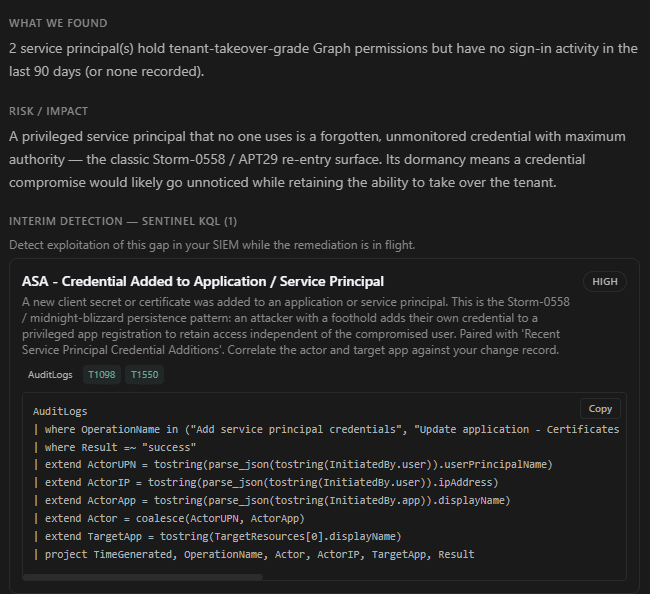
Posture findings include compensating detection rules you deploy into your Sentinel workspace with a single copy and paste. Detection rules are mapped to the threat that finding enables, so if someone exploits the gap before the fix is in place, the rule fires.
The fix, step by step.
Findings come with remediation guidance your team can follow without guessing. Some fixes are scripts you review and run. Others are step-by-step walkthroughs with actions documented and linked to relevant Microsoft Learn articles. Templates account for dependencies across your environment, so a fix in one area does not create a new exposure in another.

Findings can be routed into Splunk, ServiceNow, Jira, PagerDuty, and Slack through prebuilt webhook integrations and a public API.
See when a setting changes. Have the proof when someone asks.
When your board, your auditor, or your insurer needs proof of compliance, you already have it. The evidence comes from a platform that operates independently of the systems it evaluates.
What changed, when, and who changed it.
You see changes with before and after values, when they happened, and the account responsible. Workflow status tracks events from detection through remediation.

Open risks, with dates.
One register holds findings across your environment with their history: first discovered, last seen, current status, and whether they came back after a fix. When someone asks how long a risk has been open or what was resolved this quarter, the answer is already on the page.

Fifteen frameworks. One validation pass.
Findings map simultaneously to NIST CSF 2.0, NIST 800-53, MITRE ATT&CK, CIS Microsoft 365, CISA SCuBA, Microsoft MCSB, HIPAA, PCI-DSS v4.0, ISO 27001:2022, CIS DevOps Foundations, CIS GitHub Foundations, CIS Azure Foundations, CIS AWS Foundations, CIS GCP Foundations, and CIS Google Workspace Foundations.
An auditable evidence trail generated directly from your own environment.

Visibility starts the day your team signs in.
Getting Started with
Proactive Microsoft Security.
Your team signs in through your existing identity provider using SAML or OIDC. SCIM provisioning keeps each person’s access scoped to their role as people join, change roles, or leave. Your first tenant typically connects in under ten minutes with no agents deployed.
Scan in minutes
Visibility across your Microsoft environment in minutes. Connect once, hit scan, review findings in one place.
See your top risks
You know exactly where to focus. Findings name the specific account, policy, or role, ranked by what matters most.
See the attacker’s path
Fix what reduces the most risk first. You see how individual findings connect into the paths an attacker would follow.
See what changed
Audit-ready evidence before anyone asks. Changes go on the record with who made them and when, and that record can be checked by someone outside your company.
Security validation made easy.
Evidence on demand. Produced from your live environment.